80/50 Rule for Silver: How to Time Your Investments? (A Beginner’s Portfolio Guide)

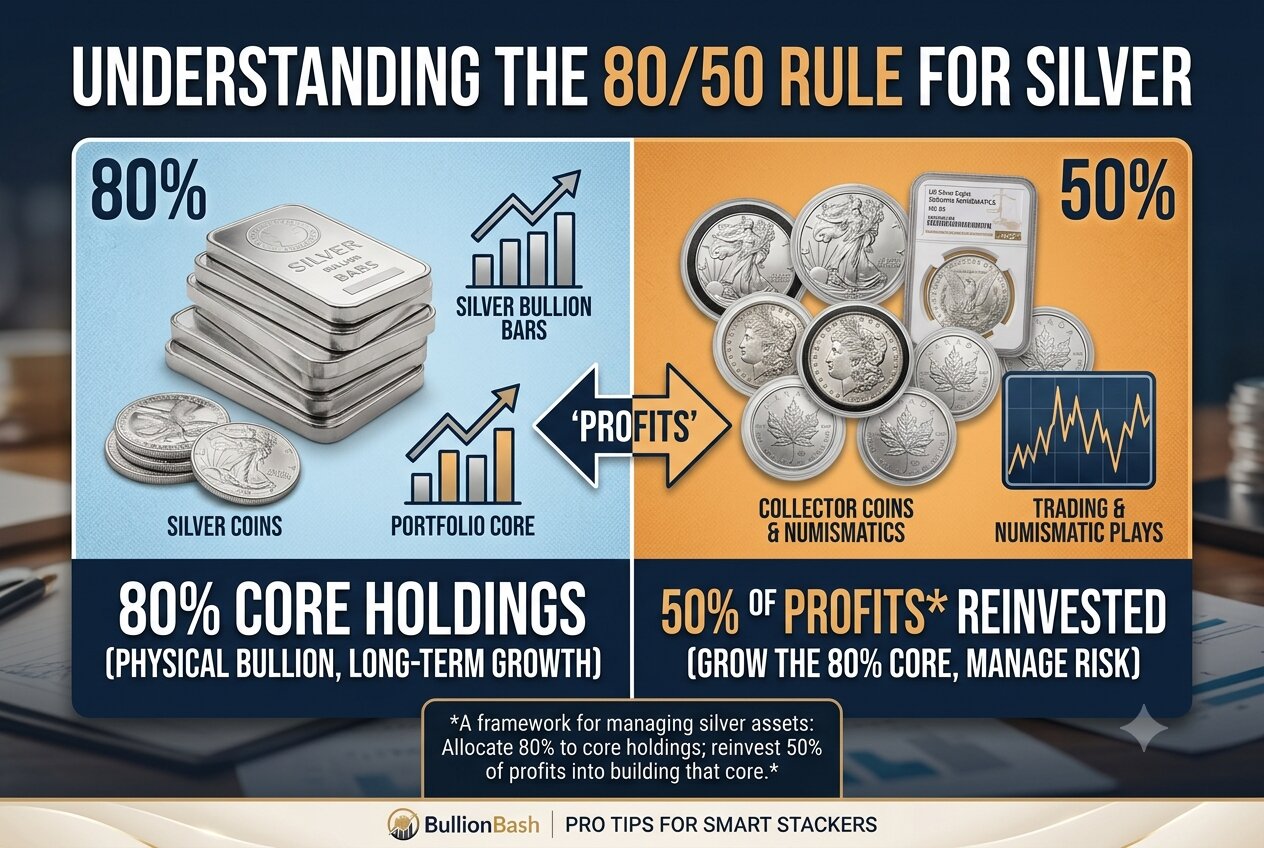
If you want to grow your precious metals portfolio without spending more cash, the 80/50 rule for silver is your ultimate secret weapon. This strategy is a simple way to decide whether you should buy gold or silver at any given moment by tracking the price relationship between the two metals. When the ratio of gold to silver prices climbs above 80, you swap your gold for silver because silver is historically cheap. When that ratio drops below 50, you swap your silver back into gold because gold has become the better deal. It is a proven, stress-free compounding strategy that smart stackers have used for decades to turn a single ounce of gold into multiple ounces completely for free.
What exactly is the Gold-to-Silver Ratio?
Before we talk about swapping metals, we need to understand the simple math that makes this whole system work. Don’t worry, you don’t need to be a math genius to get this.
Breaking Down the Math
The gold-to-silver ratio is a single number that shows how many ounces of silver it takes to buy one ounce of gold. To find this number, you just take the current price of gold and divide it by the current price of silver.
$$\text{Ratio} = \frac{\text{Price of 1 oz Gold}}{\text{Price of 1 oz Silver}}$$
For example, if gold is trading at $2,000 per ounce and silver is trading at $25 per ounce, the ratio is exactly 80 ($2,000 / $25 = 80). This means you could trade 80 ounces of physical silver for 1 ounce of pure gold.
Historical Ratios: Ancient Rome vs. Modern Days
This isn’t some new-fangled trend. Humans have been tracking this relationship for thousands of years. It is actually the oldest continuously tracked exchange rate in human history!
- Ancient Rome: Julius Caesar standardized the ratio at 12:1. That meant 12 silver coins were valued exactly the same as 1 gold coin.
- The US Founding Fathers: In 1792, the US government set the official ratio at 15:1.
- Modern Free Markets: Ever since governments stopped backing paper money with real metal in the 1970s, the ratio has gone wild. It now fluctuates constantly based on market demand, industrial needs, and investor fear.
Historically, in the modern era, the ratio spends most of its time bouncing between 50 and 80. Whenever it escapes this range, it creates a massive opportunity for smart investors.
How the 80/50 Rule for Silver Works
Now that you understand the math, let’s look at how to actually use this information to make smart moves. This is the core of the 80/50 rule for silver, and it serves as a compass for buying and selling your metal portfolio.
THE 80/50 RATIO SWING SYSTEM
| Gold-to-Silver Ratio Level | Market Signal | Suggested Action |
|---|---|---|
| Above 80 | Silver is cheap, Gold is expensive | Sell Gold and Buy Silver |
| Below 50 | Gold is cheap, Silver is expensive | Sell Silver and Buy Gold |
When the Ratio Crosses 80 (The Silver Buy Signal)
When the ratio climbs above 80, the market is telling you that silver is incredibly cheap and undervalued compared to gold. Gold is sitting on a high pedestal, while silver is practically lying in the bargain bin.
- What you do: Stop buying gold. Put all your extra savings into physical silver instead. If you want to be aggressive, you can even take some of the gold coins you already own, sell them to a local dealer, and use that cash to buy a mountain of silver bars.
- The Logic: You are acquiring as much underpriced silver as possible, waiting for the market to realize its mistake and correct itself.
When the Ratio Drops Below 50 (The Gold Swap Signal)
As the years go by, the market cycle will eventually shift. Silver will start rallying fast, and the ratio will drop down toward 50 or lower. This means silver has become expensive, and gold is now the undervalued asset.
- What you do: This is where you collect your winnings. You sell your physical silver bars and coins and use the cash to buy pure gold.
- The Logic: Because the ratio is now low, your silver has massive purchasing power. You can buy far more ounces of gold now than you could when the ratio was sitting up at 80.
Why This Simple Ratio Strategy Actually Works
You might be thinking, “This sounds too simple to be true. Can you really make money just by swapping metals?” Yes, you absolutely can. And you can do it without ever having to time the stock market or read complicated financial charts.
Market Cycles and Volatility
Let’s be totally real for a second. Silver is a wild, emotional metal. It is much more volatile than gold. When the precious metals market starts heading up, silver acts like it is on rocket fuel; it shoots up much faster than gold. But when the market crashes, silver drops like a lead weight.
This extreme volatility is exactly what makes this strategy work. The ratio acts like a rubber band. When it stretches too far in one direction (above 80), you know it has to snap back eventually.
Silver’s Hidden Industrial Power
Unlike gold, which mostly sits in bank vaults as a store of value, silver is heavily used in the real world.
SILVER’S MAJOR REAL-WORLD USES
| Industry | How Silver Is Used |
|---|---|
| Solar Panels | Silver paste is vital to solar cells. |
| Electric Vehicles | Heavy wiring and electrical connections in EV batteries. |
| Electronics & AI | Used in touchscreens, chips, and circuit boards. |
Because of solar power and modern green energy tech, factories are eating up physical silver faster than mines can dig it out of the ground. When industrial demand spikes during economic booms, it pushes silver prices up rapidly, driving the gold-to-silver ratio down toward the 50 mark.
Historical Swaps: How to Multiply Your Wealth For Free
Let’s look at a real-world example of how this compounding works over time. Imagine you started with just 10 ounces of gold in 1990 and followed this rule strictly:
| Year | Ratio | Your Portfolio Action | Total Portfolio Size After Swap |
| 1990 | 90 | Sell 10 oz Gold -> Buy Silver | 900 oz Silver |
| 1997 | 50 | Sell 900 oz Silver -> Buy Gold | 18 oz Gold (Almost doubled!) |
| 2003 | 80 | Sell 18 oz Gold -> Buy Silver | 1,440 oz Silver |
| 2011 | 32 | Sell 1,440 oz Silver -> Buy Gold | 45 oz Gold (From just 10 oz!) |
Notice that you never added a single dollar of your own money after 1990. You simply watched the ratio, made 3 simple swaps over 21 years at your local coin shop, and turned 10 ounces of gold into 45 ounces of gold. That is the pure magic of compounding physical metal!
Pro Tip: As you build your silver collection using the 80/50 rule, remember that coin condition is key to resale value. For best practices on care, check out our guide: How to Clean Silver Jewelry at Home (Complete 2026 Guide)
Practical Tips for Implementing the Ratio Strategy
While the math is easy, physically executing this strategy requires a bit of planning. You don’t want to lose all your profits to high shipping fees or greedy coin dealers.
Choosing the Right Bullion Products
If you plan to swap your metals when the ratio swings, you need to buy products that are easy to trade and have low premium fees.
- Avoid High-Premium Collector Coins: Don’t buy rare, vintage, or highly painted coins. When you go to swap them, dealers will only pay you the raw metal value, so you lose the extra premium you paid.
- Stick to Government Bullion: Buy highly recognizable coins like 1 oz .999 pure silver coins (like Silver Maples or Silver Eagles) or standard 10 oz silver bars. Every coin dealer in the world knows exactly what these are and will buy them from you instantly without questions.
- Keep Your Bars Manageable: Don’t buy giant 100 oz silver bars unless you have a strong back. They are heavy to transport and harder to sell or trade in small increments. Stick to 1 oz coins and 10 oz bars for maximum flexibility.
When to Avoid Rebalancing
Don’t get over-excited and start swapping your metals every time the ratio moves by one or two points. Rebalancing too often is a major trap.
- Watch the Transaction Costs: Every time you buy or sell metal, the dealer takes a small cut (called the spread). If you trade too often, those small fees will slowly eat away your profits.
- The Golden Rule of Patience: This is a long-term game. The ratio usually takes 3 to 5 years to move from one extreme to the other. Only make your move when the ratio solidly crosses the 80 or 50 lines. If it is sitting at 65, just sit back, relax, and do absolutely nothing.
Frequently Asked Questions (FAQs)
What is a normal gold-to-silver ratio?
Historically, a ratio between 50 and 70 is considered normal and balanced. When the ratio is in this neutral zone, neither metal is a crazy bargain, and you don’t need to make any portfolio adjustments.
Will the ratio ever return to the historical 15:1 level?
It is highly unlikely. While silver is heavily used in industry, gold remains the primary reserve asset for global central banks. Unless we return to a strict gold-backed monetary system, the ratio will likely continue to swing between modern free-market extremes.
Can I use Silver ETFs instead of physical metal for this?
Yes, you can use paper assets like Silver ETFs (e.g., SLV) and Gold ETFs (e.g., GLD) to trade instantly on your phone. However, physical collectors prefer holding real metal in their hands because it eliminates counterparty risk and protects them from potential digital banking crises.
Conclusion
At the end of the day, you don’t need a fancy finance degree to protect and grow your hard-earned wealth. By ignoring the daily news noise and simply keeping a close eye on the gold-to-silver ratio, you can take emotions out of your investing. When silver gets ignored and cheap, you stock up on it. When silver gets insanely popular and expensive, you trade it for stable, secure gold. Staying disciplined and using the 80/50 rule for silver is your ultimate roadmap to building a massive physical portfolio that will protect your family’s future for generations. Happy stacking!