How to Test Fake Gold at Home: 5 Simple DIY Methods to Avoid Scams

Let’s be totally honest for a second. There is absolutely nothing worse than that sick, gut-wrenching feeling in your stomach when you buy a shiny gold ring or a coin from a local yard sale, only to start wondering if you just got completely ripped off. With online marketplaces flooded with cheap knockoffs, it is super easy to fall victim to clever counterfeiters.
Knowing how to test fake gold at home is the ultimate way to get instant peace of mind without having to run to a professional jewelry shop and pay hefty inspection fees. While professional coin dealers use expensive scanners, you can easily filter out 90% of cheap brass, copper, or gold-plated fakes using simple things you already have in your kitchen or garage. It takes less than five minutes to run these quick checks. Let’s dive straight into how you can protect your hard-earned cash from scammers right on your kitchen table.
Why You Must Know How to Spot Fake Gold Yourself
A lot of beginner investors think that if a gold bar has a fancy plastic assay card or a shiny stamp, it must be real. But honestly, scammers are getting incredibly smart. They can easily fake plastic packaging, print fake serial numbers, and stamp “999 Fine Gold” on a piece of cheap lead or copper.
If you are buying gold coins or vintage jewelry from pawn shops, flea markets, or private sellers online, you cannot just trust their word. If you do not check the metal yourself, you might end up holding a pretty piece of metal that is worth exactly zero dollars. Running a few quick DIY checks before you add a piece to your collection is the smartest habit you can build.
Preparation: Things to Avoid Before Testing Your Gold
Before we start dropping vinegar or scraping your precious metals, we need to talk about some safety rules. Some online guides tell you to do crazy things that can permanently ruin your assets.
Don’t Use Harsh Chemical Acids Lightly
You might have seen people online dumping strong nitric acid on their rings. Unless you are a professional jeweller wearing heavy safety gear, please do not play with strong acids. Not only can you burn your skin, but you can also permanently dissolve or discolour real gold jewelry if it is mixed with other alloy metals (like 10k or 14k gold).
Clean the Surface Gently First
Dirt, sweat, and oil from your hands can mess up basic physical tests. Before you start, wipe your metal item with a soft microfiber cloth. Do not use harsh steel wool or abrasive scrubs, as they will scratch the delicate surface of your pure gold and lower its resale value.
Editor’s Note: This guide was manually tested and updated in June 2026 using real gold bullion and scrap jewelry. We used Android and iOS tools to check weights and sound frequencies. This is a practical, step-by-step troubleshooting guide for physical metal collectors.
5 Easy DIY Tests to Detect Fake Gold at Home
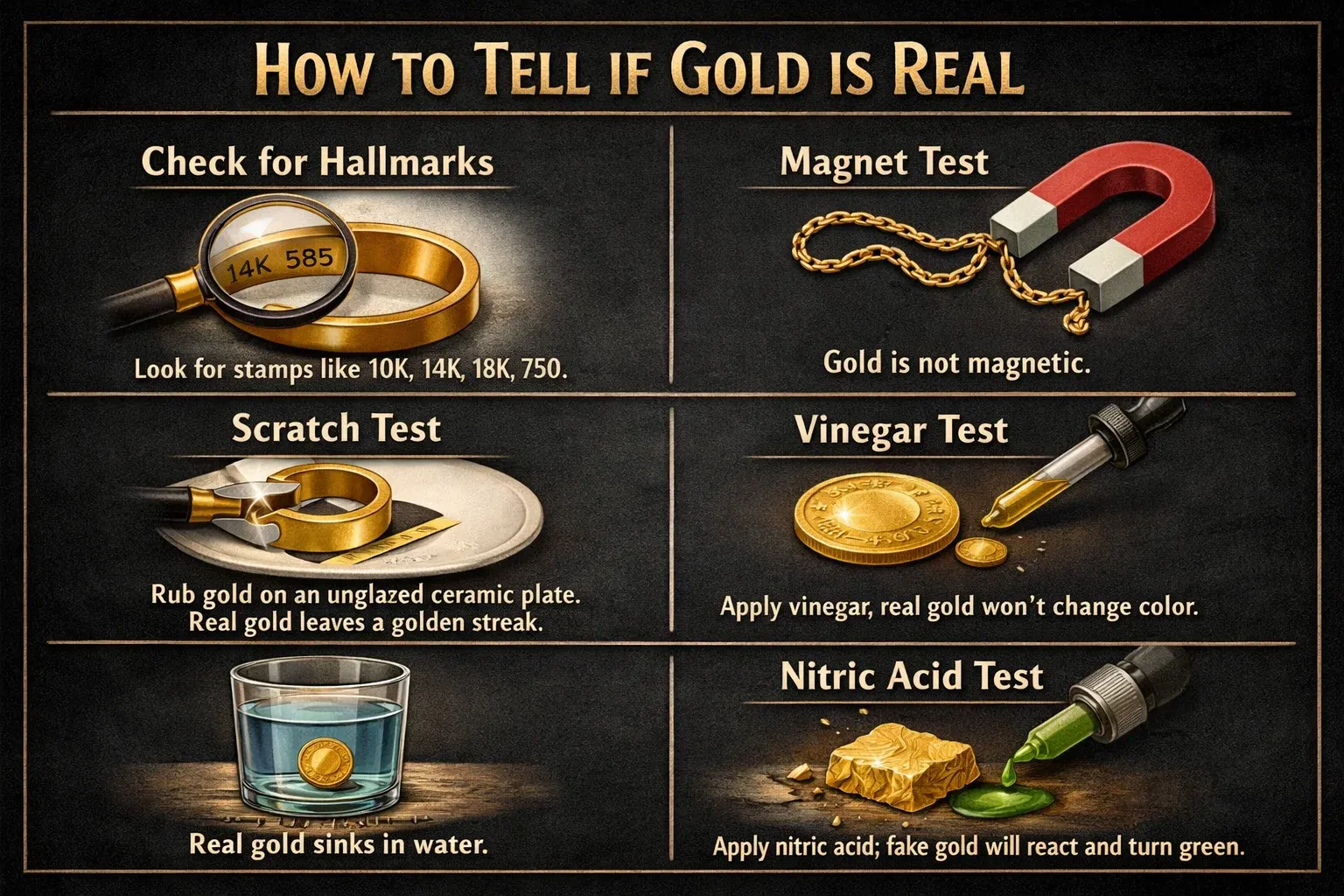
Here are the five most reliable, human-tested methods you can perform at home. For the best results, do not rely on a single test. Try at least two or three of these to be absolutely sure about your metal.
DIY GOLD TESTING CHECKLIST
| Test Name | What You Need | Real Gold Reaction |
|---|---|---|
| Magnet Test | Neodymium Magnet | No movement (not magnetic) |
| Float/Density Test | Glass of Water & Scale | Sinks fast, high density |
| Ceramic Scratch Test | Unglazed Ceramic Tile | Leaves a gold-yellow line |
| Vinegar Test | Standard White Vinegar | No colour change at all |
| Sound Ping Test | Coin or Wooden Pencil | Long, high-pitched ring |
Test 1: The Neodymium Magnet Test (The Quickest Check)
This is the absolute first thing you should do. Real gold is a noble metal, which means it is completely non-magnetic. It will never stick to a magnet, no matter how strong it is.
- What you need: You cannot use a weak, colourful magnet from your kitchen fridge for this. You need a strong neodymium magnet (you can get one cheaply at a hardware store or extract one from an old computer hard drive).
- How to do it: Place your gold item on a flat wooden table. Slowly bring the strong magnet close to the item.
- The Result: If your gold coin slides toward the magnet or sticks to it, it is a flat-out fake. It is likely made of steel, iron, or nickel with a thin gold plating.
- The Catch: Keep in mind that copper, lead, and aluminum are also non-magnetic. So if a coin passes the magnet test, it still might be a copper fake. You need to move on to the next test to be sure.
Test 2: The Water Float and Density Test (Checking the Weight)
Real gold is incredibly heavy and dense. In fact, it is one of the densest metals on the planet ($19.3 \text{ g/cm}^3$). Most fake metals, such as copper or tin, are much lighter.
- What you need: A clear glass filled with normal tap water and a small digital kitchen scale.
- How to do it:
- First, weigh your gold item on the digital scale in grams and record the weight.
- Gently drop the item into the glass of water.
- The Result: Real gold will sink like a stone straight to the bottom instantly.
- How to Calculate Real Density: If you want to get nerdy and scientific, fill a small container to the absolute brim with water, place it inside a bowl, and drop your gold in. Weigh the water that spills out into the bowl. Divide your gold’s weight by the weight of the spilled water. If the number is close to $19.3$, you are holding pure gold. If the number is around $8$ or $9$, it is cheap brass or copper.
Test 3: The Ceramic Plate Scratch Test
This is a classic method that scrap gold hunters use. It is very accurate, but a quick warning: this test can leave a tiny, microscopic scratch on your item, so do not do this on highly expensive numismatic coins.
- What you need: A piece of unglazed ceramic tile or a plain white ceramic plate (make sure it is unglazed, meaning it does not have a shiny, smooth protective coating).
- How to do it: Take your gold piece and gently scrape it across the rough ceramic surface, as if you were drawing a line with a pencil.
- The Result: Look at the colour of the streak left behind on the tile:
- If it leaves a bright golden-yellow line, your gold is real.
- If it leaves a black, grey, or dark green line, it is fake. You are likely dealing with pyrite (commonly known as “fool’s gold”) or a base metal hidden under a thin golden wash.
Test 4: The White Vinegar Kitchen Test
This is a super safe chemical test that won’t harm your real metal. Vinegar contains acetic acid, which reacts with cheap base metals but has absolutely zero effect on real gold.
- What you need: Normal white vinegar from your kitchen pantry and a small cup.
- How to do it: Place your gold item in the cup and pour enough vinegar to completely cover it. Let it sit there for about 5 to 8 minutes.
- The Result: Take the item out and rinse it with clean water.
- If the metal looks exactly the same—bright, shiny, and golden—it is real.
- If the metal turns black or green, or develops dark spots, the acid in the vinegar has reacted with the copper or zinc in the fake alloy.
Test 5: The Ping Sound Test (For Gold Coins)
While learning how to test fake gold at home saves you time, the sound test is the most satisfying method for coin collectors. Real precious metals make a very distinct, beautiful sound when tapped, which is almost impossible for cheap metals to replicate.
- What you need: Your gold coin and a small wooden pencil or another known real coin.
- How to do it: Balance your gold coin on the tip of your index finger (do not grip it tightly; let it balance freely). Gently tap the edge of the coin with the wooden pencil.
- The Result: Listen closely to the sound:
- Real Gold: It produces a high-pitched, clear, crystal-like ringing sound that vibrates and lasts 2 to 3 seconds. It sounds like a tiny bell.
- Fake Gold: It will make a dull, flat “clonk” sound that stops instantly. This is because copper and lead absorb the sound waves instead of letting them ring.
Understanding Gold Purity Marks and Stamps (Hallmarks)
Real jewelry and bullion almost always carry official stamps called hallmarks. These stamps tell you the exact purity of the gold. While counterfeiters can fake these stamps, knowing what they mean helps you spot the obvious errors.
Common Gold Stamps to Look For
- 24K / 999: This means 24 Karat gold, which is $99.9\%$ pure gold. This is the gold used in investment bars and high-end bullion coins.
- 18K / 750: This means 18 Karat gold, which is $75\%$ pure gold and $25\%$ other metals (like silver or copper to make it stronger).
- 14K / 585: This is the most common jewelry stamp. It means $58.5\%$ pure gold.
- 10K / 417: This is the minimum purity allowed to be called gold in the US ($41.7\%$ pure).
Red Flag Stamps to Avoid
If you see any of the following letters stamped next to the karat number, your item is not solid gold. It is just a cheap metal with a microscopic gold wash:
- GP: Gold Plated
- GF: Gold Filled
- GEP: Gold Electroplated
- HGE: Heavy Gold Electroplated
If you bought a ring thinking it was solid gold, but you find a tiny “14K GP” stamp inside, you have been scammed. It is just cheap brass with a very thin layer of gold on top that will rub off in a few weeks.
When Should You Take Your Gold to a Professional?
While these home DIY tests are incredibly helpful, there is one major exception to the rule: Tungsten.
Tungsten is a metal that has almost the exact same density ($19.25 \text{ g/cm}^3$) as gold. This means a gold-plated tungsten bar will easily pass the magnet test, the water float test, and the density test. Scammers love using tungsten because it feels heavy and expensive in your hand.
If you are dealing with high-value assets—like a 1 oz gold bar worth thousands of dollars—you should never rely solely on home kitchen tests. Take your metal to a trusted local coin shop or a professional jeweller. They have high-tech machines called XRF (X-ray Fluorescence) Spectrometers. These machines shoot safe X-rays into the metal to read its exact atomic structure without scratching or damaging your precious asset. It takes 10 seconds and is 100% accurate.
Frequently Asked Questions
Can you test gold with a standard lighter?
Yes, but you have to be very careful. Real gold does not burn, turn black, or melt under a normal lighter flame. If your item is gold-plated, the intense heat will melt the thin layer of gold, revealing the dark copper or lead underneath. However, cheap jewelry can get permanently ruined by soot, so we don’t recommend this as your first choice.
Why does my gold ring turn my skin green?
If your skin is turning green or black under a ring, it means the ring has a high copper or nickel content. Real 24k gold will never discolour your skin. However, 10k or 14k gold is mixed with copper, and the natural acids in your sweat can react with that copper, causing a harmless green mark. If it’s labelled 24k and turns your skin green, it is fake.
Will vinegar damage a 14k gold ring?
No. Standard white vinegar has a very low acid level. It is completely safe to use on 14k, 18k, or 24k gold. It will react only with base metals (such as copper or iron) if the item is counterfeit or heavily plated.
Conclusion
At the end of the day, protecting your physical metal portfolio does not have to be complicated or expensive. By keeping a strong neodymium magnet in your drawer, using a simple kitchen scale, and keeping an eye out for sneaky plating stamps like “GP” or “GF,” you can easily weed out the cheap counterfeits. Just remember to use a combination of different methods to get the most accurate result, and never hesitate to consult a professional dealer for high-value coins. Knowing how to test fake gold at home is your absolute best shield against scams, ensuring your physical wealth remains completely safe, secure, and genuine. Happy collecting!